There’s been a lot of chatter in our industry lately about the impact of AI tools on search traffic. While Google continues to deny that search traffic is in jeopardy, a recent report showed news and entertainment sites saw declines of up to 25% as a result of its “AI Overviews.”
Why pore through a list of results hoping to find relevance when you can read the CliffsNotes?
Some communications pros are calling this shift a “collapsed sales funnel.” Forbes contributor Danielle Sabrina writes:
“The traditional buyer journey – the familiar path from awareness to consideration to decision – is disappearing. Today’s buyers are moving faster, skipping steps and often making decisions after a single trusted source validates your brand.”
I’m also seeing excitement about the outsized role public relations plays in how language learning models (LLMs) answer the questions people plug into tools like ChatGPT, Perplexity and Gemini. Over the summer, Muck Rack analyzed more than a million links cited by AI tools and reported that a whopping 89% came from earned media. Public relations has always been about trust and credibility, so it’s nice to see that continue in the AI era.
Is AEO the new SEO?
These behavior changes are giving rise to a new approach to reaching target audiences online. After years of search engine optimization, we’re now talking about answer engine optimization (or generative engine optimization, as some call it).
Our friends over at Spyre Marketing wrote a great blog post on this topic. We partner on education clients – which is their sole focus – and they’re really good at generating demand among district decision-makers. Check out “The Future of Search Is Here. Is Your Education Business Ready for AEO?” Pay close attention to the “Get Mentioned Beyond Your Site” advice. That’s where earned media comes into play.
In addition to what Spyre shared, we’ve also seen how employer review sites (i.e., Glassdoor and Indeed) inform answer engine results. Many companies choose to ignore the negative reviews, but they might reconsider if they knew how often they train LLMs. Also, don’t count out your own website. As Spyre points out, useful landing pages that answer questions people are asking are a good place to start. Not too long ago, I was doing research for one client (a library system here in New Jersey) and ChatGPT answered my question based on the blog post of another client (a global playground equipment manufacturer). I wanted to know if investments in public infrastructure (like libraries and, it turns out, playgrounds) increased home values. Spoiler alert: They do.
Can Sales Leads be Attributed to PR?
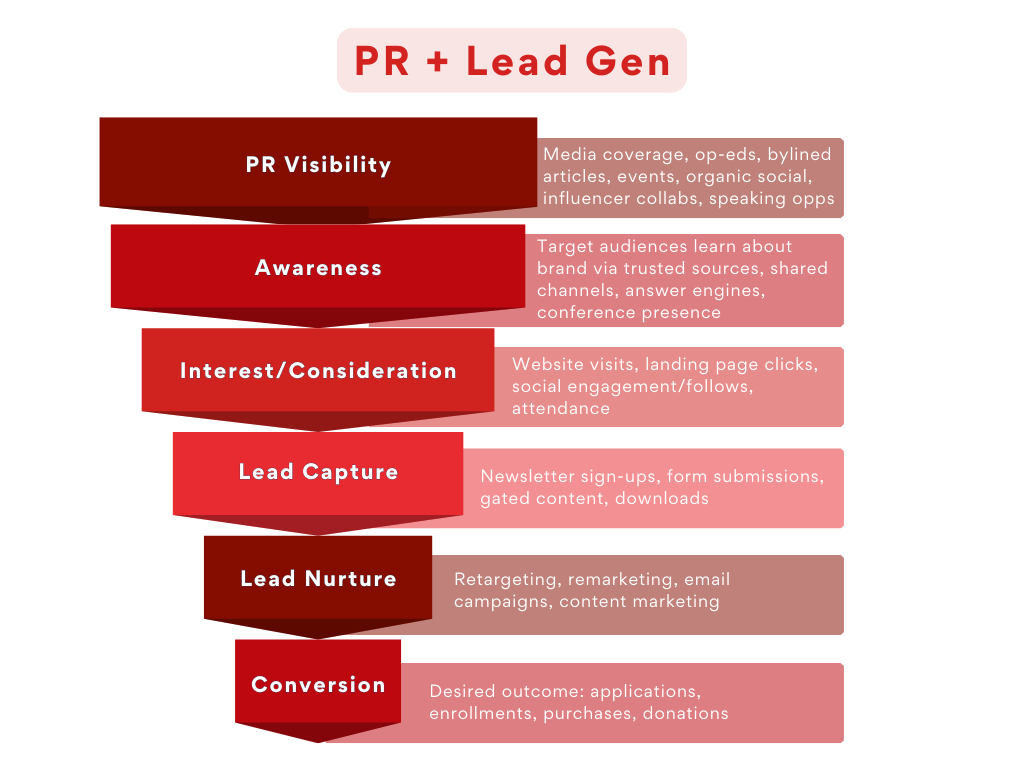
Over time, we’ve been able to more directly connect PR to conversions, whether that’s a purchase, an enrollment or a donation. The renewed focus on earned media in a collapsed sales funnel is certainly cause for optimism. At the same time, we cannot let our excitement allow us to forget that journalism is in jeopardy. We have to continue to advocate for press freedom and support the outlets we (and our target audiences) depend on with subscriptions and advertising/sponsored content revenue. It’s already tougher than ever to score earned media hits and it will only get harder as newsrooms shrink and outlets shutter.
I also believe it’s premature to predict we’re fully moving into a “zero click” era where prospective customers rely on one AI-generated result to make a decision. Perhaps that’s a reality for a new lipstick or an energy drink, but let’s not get ahead of ourselves. For many desired outcomes, it’s essential to consider how AI and PR are transforming the traditional lead generation funnel.
Take a look at our updated “PR + Lead Gen” graphic below and let me know what you think.